Casino Royale
Casino RoyaleCasino Royale is the principal setting for James Bond’s contest with Le Chiffre, a gambling house whose ordered tables give chance the appearance of procedure and make financial risk a public spectacle. The casino hosts the baccarat duel in which Bond’s fortunes collapse before recovering in a decisive wager, and it becomes the stage for the operation’s success and the attention that follows.
Setting and Atmosphere
The casino’s rooms are organized around distinct games and levels of play. At the private top table, Le Chiffre appears to be winning, with a disordered pile of hundred-thousand-franc plaques and half-million-franc plaques partly concealed beside him. The surrounding atmosphere is not merely luxurious: at three in the morning, the combination of gambling, tension, and fatigue has become oppressive enough that Bond recognizes his own exhaustion and steps away from roulette to observe the table.
The casino also has a carefully controlled infrastructure. Its cashier works behind a high barrier, with money and plaques arranged on shelves and security measures intended to prevent theft. Elsewhere, a brass rail encloses the baccarat table; a velvet-covered chain marks the entrance, and the croupier and chef de partie oversee the game. These boundaries distinguish spectators from players and formalize who may enter, deal, or supervise.
Gambling as a Social Ritual
Bond’s response to the casino is more complex than a pursuit of money. He values the cards, the rooms, the service, and the opportunity to watch other players make decisions before facing his own. He regards gambling as a contest in which a player must accept personal responsibility: chance can be recognized and used, but bad judgment should not be mistaken for bad luck. The casino therefore offers both entertainment and a test of disciplined self-assessment.
Roulette makes the tension between procedure and chance visible. Bond studies the session’s results even though he knows that one spin has no connection to the previous one. The croupier’s precise sequence—setting the ball and wheel in motion in opposite directions—helps prevent either personal skill or a wheel’s bias from determining the result. Yet Bond still attends to patterns in the run of numbers, believing that the effort and ingenuity brought to gambling matter even when they cannot control the outcome.
Baccarat gives that ritual a more consequential form. Before play, Bond explains that Le Chiffre has purchased the bank from the Egyptian syndicate operating the high tables for a million francs, leaving him with twenty-four million in capital; Bond has roughly the same amount. He intends to attack the bank whenever an opportunity arises, continuing until either he or Le Chiffre is ruined. The rules and table arrangements shape this contest: players may accept or pass the banker’s stake, and the banker’s decisions are informed by what the other player does. In Bond’s account, even the choice to draw or stand can disclose information, while a five remains a particularly uncertain hand.
The Baccarat Confrontation
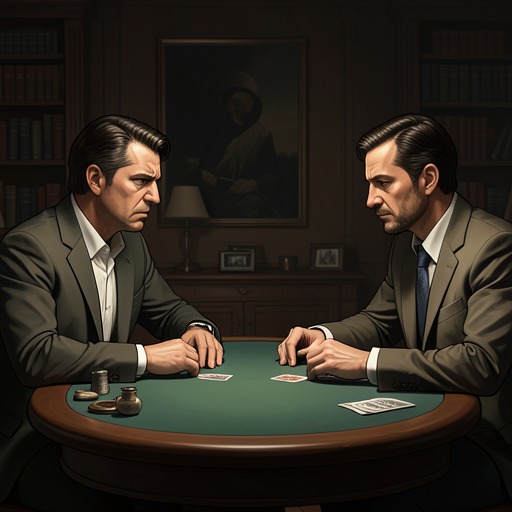
Bond enters the baccarat room carrying his twenty-four million francs, divided into equal packets in his two coat pockets. Le Chiffre takes the banker’s chair directly opposite him. The croupier places six shuffled packs into the shoe in full view, and the table’s opening wager is announced aloud. The game proceeds through repeated deals, declared stakes, and decisions to follow or pass; the subdued phrases exchanged across the table become a recurring public ritual.
The contest first turns sharply against Bond. After two coups, he has lost twelve million francs, leaving him with precisely sixteen million—the amount of the next bank. He continues to follow. Later, with the stakes having grown to thirty-two million francs, Bond recognizes that he must meet the bank rather than allow the other players to share it. Le Chiffre needs another eight million to reach fifty million and leave the table; Bond believes that an all-table stake could unsettle him, since Le Chiffre may assume Bond has only limited reserves. Bond’s actual remaining resources are hidden from his opponent, and his decision to follow the full thirty-two-million-franc bank turns that information gap into a strategic risk.
The wager draws attention beyond the players. Word of the thirty-two million spreads through the casino, and spectators crowd around the table, for many of them the sum exceeds a lifetime’s earnings. The scene makes the casino’s public character unmistakable: a decision made between banker and player becomes a spectacle in which the crowd measures the stake against its own means. Bond’s physical composure is also under pressure; when he decides to proceed, he grips the edge of the table and adjusts his seat while feeling the gun-sight at his back.
Bond ultimately wins the baccarat confrontation. The croupier pushes the plaques across the table, and Le Chiffre leaves without a word. Bond tips the chef de partie, asks for his winnings to be taken to the cashier, and meets Vesper and Felix Leiter after the other players disperse. In the directors’ private office, he adds the contents of his pockets to the chips; the total exceeds seventy million francs. The casino’s procedures thus register the reversal materially: the depleted player who had risked his remaining stake leaves with a fortune, while the banker who had appeared to control the table departs.
Aftermath and Narrative Significance
The casino’s importance extends beyond the result of the game. Bond’s victory is the operation’s central public success, and its scale attracts international press attention. Reporters at Royale try to identify the Jamaican millionaire who defeated Le Chiffre. Vesper protects Bond’s cover by saying that he has gone to gamble with his winnings in Cannes and Monte Carlo, while René Mathis and the police erase other traces and the press is redirected toward Strasbourg and turmoil among the French Communists.
Casino Royale consequently functions as both a gambling venue and a theatre of information. Its rules make wagers legible, its barriers and supervisors organize participation, and its spectators convert a private contest into public reputation. But the procedures cannot remove uncertainty: Bond studies past results while acknowledging roulette’s independence, and at baccarat he must commit capital without knowing how Le Chiffre will respond. The casino’s defining drama lies in that tension between an orderly game and an outcome no player can command.